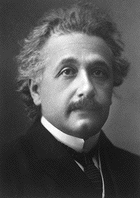
 ALBERT EINSTEIN
Science
Born: March 14, 1879
Ulm, Germany
Died: April 18, 1955
"Imagination is more important than knowledge."
Albert Einstein, physicist, philosopher and humanitarian, developed the theory of relativity. As a kid, Einstein showed no early signs of genius. His father ran a small electro-chemical plant with his uncle, who introduced him to algebra and geometry. Einstein's interest was drawn to theoretical physics, but he often skipped classes at the Federal Polytech school in Zurich, preferring to work on his own.
Einstein worked at the patent office in Bern, Switzerland from 1902 to 1909. During this period he completed an astonishing range of theoretical physics publications, written in his spare time, without the benefit of close contact with scientific literature or colleagues.
The most well known of these works is Einstein's 1905 paper proposing "the special theory of relativity." He based his new theory on the principle that the laws of physics are in the same form in any frame of reference. As a second fundamental hypothesis, Einstein assumed that the speed of light remained constant in all frames of reference.
Later in 1905 Einstein showed how mass and energy were equivalent expressing it in the famous equation: E=mc2 (energy equals mass times the velocity of light squared). This equation became a cornerstone in the development of nuclear energy.
Einstein received the Nobel Prize in 1921 but not for relativity, rather for his 1905 work on the photoelectric effect. He worked on at Princeton until the end of his life on an attempt to unify the laws of physics.
In the 1920's and 30s he lectured abroad. In 1941, with the onset of World War II, Einstein immigrated to the United States. A vocal pacifist, Einstein was concerned about the social consequences of scientific inventions such as nuclear energy.
1. Albert Einstein often __________ his classes at the Federal Polytech.
2. According to Einstein the speed of light remains __________ in all frames of reference.
3. Einstein proposed that mass and energy were equivalent in his equation E= __________ .
4. Later in life Einstein became a vocal __________ .
Your score is out of 4
