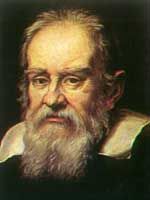
 Most historians consider Galileo (usually known by his first name only) as the first scientist of the Scientific Revolution. His greatest fame is for refining the telescope, and discoveries in astronomy (moons of Jupiter, phases of Venus, and much more), but his influence on physics is pervasive; the observation that all bodies fall at the same speed in a vacuum is just one of Galileo's ideas that led to the laws of motion and eventually to relativity theory. Galileo also contributed to the study of mathematical infinity. His influence comes not only through his persuasive and popular books about the solar system, kinematics, and materials, but also as a result of his inventions (the astronomical telescope and the thermometer), his correspondence, and his pupils and assistants. Galileo promoted Copernican views as early as 1604 and did not stop when in 1616 the church declared such ideas to be heresy. As a result, Galileo was put before the Inquisition and informed that he must recant or be tortured. He recanted, but spent the last years of his life under house arrest, during which time he wrote and published his most influential work on physics, Dialogue on Two New Sciences.
1. Galileo is considered the __________ scientist of the Scientific Revolution.
2. Galileo discovered the moons of __________ .
3. Galileo discovered all bodies fall at the same speed in a __________ .
4. Galileo invented both the telescope and __________ .
Your score is out of 4
