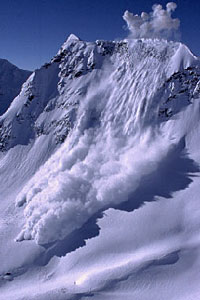
 Imagine you're skiing the deep snow of a mountain pass when you hear a low
rumble. The snow beneath you suddenly gives way. In a terrifying instant you
realize you've been caught in an avalanche.
Imagine you're skiing the deep snow of a mountain pass when you hear a low
rumble. The snow beneath you suddenly gives way. In a terrifying instant you
realize you've been caught in an avalanche.
A roaring sea of snow envelops you and you are buried under snow compacted as
hard as concrete. Rescue must come fast. After only 30 minutes your chances of
survival are 50 percent. If you are not equipped with an avalanche rescue beacon,
your next best hope is a search-and-rescue (SAR) team working with avalanche rescue dogs.
How can a dog pick up your scent through densely packed snow, recognize the
scent as the important one, and then hone in on it? Part of the answer is the
dog's olfactory system, which is
10,000 to 10 million times more sensitive than
a human's. Dogs have about 220 million scent cells, compared to about 5 million
in humans. Scent cells, or cilia,
react to odor-carrying molecules that flow
into noses. In dogs, these cells line the canine mucosa, a membrane at the rear
of the snout which is folded so many times that, if smoothed out, it would be
larger than the dog's body. When the hairlike cilia encounter an odor-carrying
molecule, they trigger nerve cells that signal the dog's brain.
 It takes three to six years to teach a dog to track a human scent, for the dog
must learn to pick up and follow an individual scent it hasn't smelled before,
and do it in rough terrain amid distractions. The task is made more difficult
when the victim is buried under an avalanche and has left no scent trail.
It takes three to six years to teach a dog to track a human scent, for the dog
must learn to pick up and follow an individual scent it hasn't smelled before,
and do it in rough terrain amid distractions. The task is made more difficult
when the victim is buried under an avalanche and has left no scent trail.
Dogs can smell a buried person because our bodies constantly shed skin cells and
give off odors in the form of gases. A person walking across the ground leaves
these cells and odors in a scent trail the dog can follow. A person buried under
snow leaves no such trail, but dogs use air scenting to smell the human odors,
or gases, rising up through the snow.
A dog searches an area until it finds the spot where the odors are strongest,
then alerts rescuers by barking or digging. For dogs, tracking and searching is
just a game. For the buried victim, it's a matter of life and death.
1. The cell that transmits electrical signals to the brain and other parts of the body; also called a neuron.
olfactory
synapse
dendrite
nerve
2. Small hairs that move when stimulated and trigger nerve impulses that send signals to the brain.
peach fuzz
cilia
quills
transmitters
3. Finding odors that are drifting through the air without having an odor trail to follow on the ground.
extra sensory perception
type matching
air scenting
sensory detecting
4. The combination of mucus, cilia, nerve cells, and other structures that allow animals, including humans, to smell odors
olfactory system
smelling system
tactile system
odiforous ability
5. The "search and rescue" acronym commonly used by rescue groups and a good search word on the Internet.
SAS
SCUBA
SAR
ACLU
6. Trapped in an avalanche your chances of survival after 30 minutes is ____ %.
50
25
33
75
7. Dogs have about ____ scent cells.
50
2 thousand
22 million
220 million
Your score is out of 7.
