
|
|
Ancient Rome |

Questions
 To the west of Athens, on the Italian peninsula, lay the city of Rome. Rome grew to become the heart of an important new civilization.
Rome began as a small city on the banks of the Tiber River.
It grew until it controlled the entire Italian peninsula and then expanded far beyond to a vast empire extending northward into Britain and southward to northern African and the Middle East.
Civilization in Rome developed later than did Egypt, Mesopotamia, China, and Greece. As Rome began to grow, it borrowed freely from these earlier civilizations. According to one early Roman, "The Romans eagerly copied any good idea, whether it was from a friend or an enemy."
2000-1000 BC
Indo-European immigrants slowly inhabit Italy by way of the Alps. They bring the horse, the wheeled cart, and artistic knowledge of bronze work to the Italian peninsula. Two different groups, the Greeks and the Etruscans, occupy different regions of the peninsula during the eighth century.
753 BC
Roman archeological research indicates that the founders of Rome itself are Italic people who occupy the area south of the Tiber River. By the sixth century BC, Rome will have become the dominant power of most of its surrounding area. Their conservative government consists of a kingship, resembling the traditional values of the patriarchal family; an assembly, composed of male citizens of military age; and a Senate, comprised of elders who serve as the heads of different community sects.
600 BC
Rome The Etruscans, believed to be natives of Asia Minor, establish cities stretching from northern to central Italy. Their major contributions to the Romans are the arch and the vault, gladiatorial combat for entertainment and the study of animals to predict future events. The Greeks establish city-states along the southern coast of Italy and the island of Sicily. Their contributions to the Romans are the basis of the Roman alphabet, many religious concepts and artistic talent as well as mythology.
509 BC
Rome The Roman monarchy is overthrown and replaced with a republic. For more than two centuries following the establishment of the Roman Republic, Rome is constantly at war with the other inhabitants of Italy (the Etruscans and the Greeks).
494 BC
The first victory of the plebeian class over the patricians results in agreement between the two classes to allow the plebeians to elect officers, tribunes, with the power to veto any unlawful acts of the magistrates.
450 BC
The Law of the Twelve Tables is established allowing the plebeians to have knowledge of their relationship to the law. The plebeians are primarily farmers, craftsmen and tradesmen with foreign background. The patricians make up an aristocracy.
367 BC
The first plebeian consul is elected to the assembly, and plebeians become eligible to serve as lesser magistrates, formerly a position only granted to the aristocratic class. Because an ancient custom allows promotion from magistracy to the Senate, the patrician-dominated Senate is broken.
Rome, has been the the capital city of modern Italy since 1871, is a city with an incredibly rich history. It was the main city of the vast Roman Empire, whose control reached from Rome to places as far away as England. The Roman Empire left an enduring legacy throughout Western civilization -- and many enduring ruins throughout Rome.
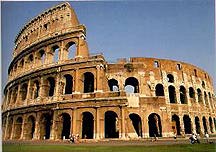
The proper name of the Colosseum is the Flavian Amphitheatre. Nero never turned "thumbs down" on anyone in the Colosseum. Though he planned its construction--as part of a never-completed larger and more lavish palace complex--he died before it was opened in 80 A.D.
The word Colosseum comes from a "colossal" statue of Nero that once stood near the stadium. (See the picture above)
The Colosseum had a canvas roof--the velarium--raised and lowered by a specially trained team of Roman sailors known for their skill with rigging ships. The canvas "big top" had a large hole in the center to admit more light.
The Colosseum's spectator capacity was about 50,000 persons--dignitaries, their guests, their slaves, a select number of common people, and "foreigners"--people who did not hold Roman citizenship. Commoners, slaves and foreigners were seated right under the canvas roof, where it was hottest.
The word "arena" is Latin for sand. Sand was spread across the amphitheater fighting floor to soak up blood.
Deceased gladiators and animals killed in exhibitions at the Colosseum had their own exit. It was called the Libitinarian Gate--after Libitina, the goddess of funerals.